
Moving from traditional "goop" impressions to a digital scanner (such as iTero) is like trading a flip phone for the latest smartphone.
If you’re a patient curious about the chair-side experience, here are the primary benefits:
1. Enhanced Patient Comfort
The most immediate benefit is the elimination of PVS (Polyvinyl Siloxane) impressions.
-
No Gagging: No more large trays filled with cold, messy putty that often triggers a gag reflex.
-
Breathability: Patients can breathe and swallow normally during the scan.
-
Speed: A full-arch scan can often be completed in under 60 seconds.
2. Superior Accuracy and Fit
Digital scans eliminate the variables that often lead to "remakes" in traditional dentistry.
-
No Distortion: Putty can tear, bubble, or shrink. A digital file remains 100% stable.
-
Real-time Validation: The software alerts the operator if a spot was missed, allowing for an instant "patch" rather than starting the whole process over.
-
Better Restorations: Crowns, bridges, and Invisalign aligners tend to fit better on the first try, reducing chair time for adjustments.
3. The "Invisalign Outcome Simulator"
One of iTero’s "killer features" is the ability to show patients their future smile before they even start treatment.
-
Visual Motivation: It maps out the current teeth and simulates the final alignment.
-
Progress Tracking: Using the TimeLapse tool, doctors can compare scans over months or years to identify tooth wear, gingival recession, or tooth movement.
4. Streamlined Workflow
Since the files are digital, the "logistics" of dentistry become much faster.
-
Instant Lab Submission: Scans are sent to the lab or Invisalign via the cloud instantly—no more waiting for couriers or shipping boxes.
-
Digital Archiving: No need for physical storage space for bulky stone models.
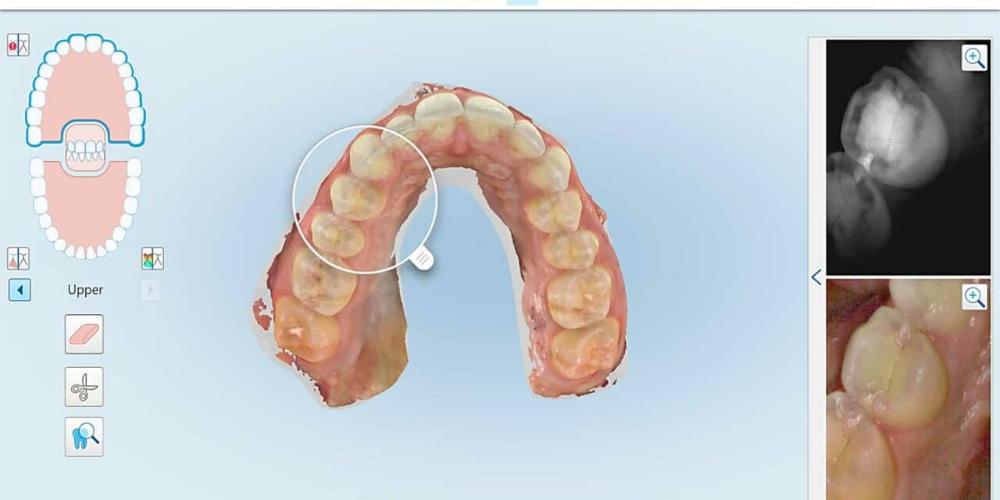
5. NIRI technology: Near-Infrared Imaging.
NIRI uses near-infrared light to penetrate the hard enamel and reflect off the underlying structure.
Because healthy enamel and decayed enamel reflect light differently, the scanner can "see" through the tooth.
-
Radiation-Free Detection: Unlike X-rays, NIRI uses light.
This makes it a safe way to monitor teeth more frequently, which is especially helpful for pregnant patients or children. -
Interproximal Caries (Cavities) Detection: Its "superpower" is finding cavities hiding between teeth—areas that are often invisible to the naked eye until they become a major problem.
-
Early Intervention: It can spot "demineralization" (the very beginning of a cavity) before it fully breaks through the enamel. This allows for preventative treatments (like fluoride) rather than a drill-and-fill approach.